| Written for a class in Fall 2016 | Download file |
The long-ailing Hollins Market’s vendors and patrons are disconnected, sales are down, and vendors are disappearing. Redevelopment efforts in the area are nothing new, but residents are hopeful that recent interest brings more economic success to the area.
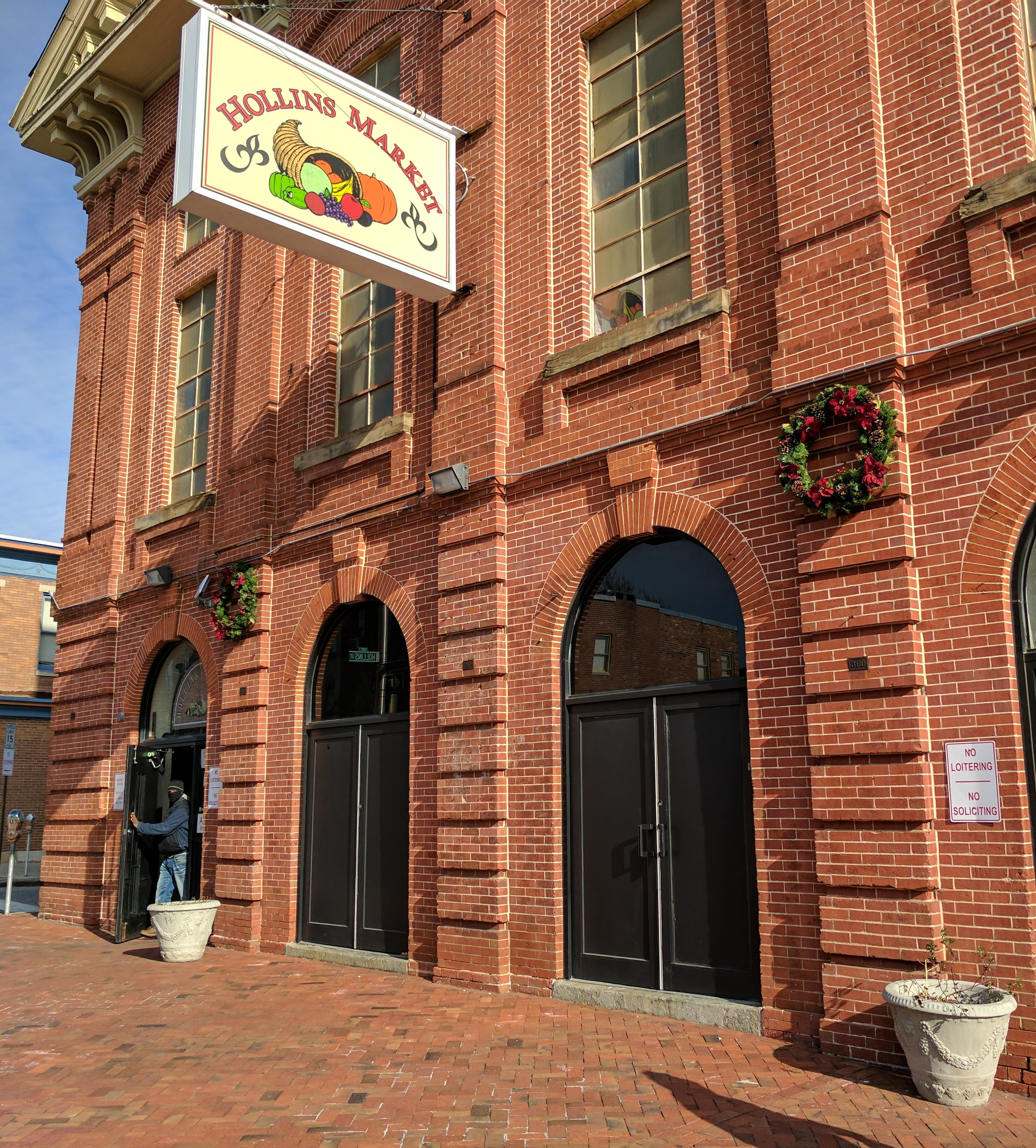
Hollins Market is imposing. The main portion of the block-wide building stretches upward, a red brick monolith twice the height of the surrounding buildings. The rest of the building, long and stout, takes up the remainder of the block, its white panel façade reaching all the way to the end of the block.
The market, built in 1838, and for many years a thriving source of meats, produce and prepared foods, has been failing for decades. Few people shop there, and when vendors leave there is rarely someone willing to take their place. The market itself is old, with half of the building closed off and chips in the brick showing. Area community organizations have responded in force, and based on their desires, developers are showing interest in the market.
But redevelopment often comes with a price, and some worry about the effects of gentrification on both the vendors in the market and the residents outside it. Others, however, are clamoring for change in a neighborhood that has seen historical neglect.
The neighborhood
Just across Hollins street, on a Thursday afternoon in November, yellow caution tape lines the sidewalk. Men on ladders work with the red brick on the small streetside commercial space while a man watches from the curb, yelling questions at the workers. His shirt is plaid, his beard salt- and-pepper. Bif Browning is not a foreman, but the head of the Union Square Neighborhood Association.
The building, he says, has been neglected. Brickwork repairs are expensive, and the building’s owner had put off the work. Just a week ago a brick dropped out of the mortar, injuring a woman and her dog. The dog fared worse, he says: “Broke all four legs.”
It is not just the buildings in the Hollins Market neighborhood that have aged poorly. Southwest Baltimore has faced major disinvestment over the past century, and it shows: around 30 percent of the houses in the area lay vacant, and the area has higher crime rates than the city generally. Previous development efforts have done little to reverse this trend.
Businesses in the area, Browning says, can’t survive unless they operate during the evening. “There’s just not daytime food traffic,” he says. “We need some office jobs or something around here or factory jobs, where you’ve got a big amount of people who get turned out at some point during the daytime.”
JR Lee, owner of tex-mex restaurant Mi Ranchito–an establishment sitting directly adjacent to the crumbling façade–agrees. But commercial challenges, he feels, are not limited to restaurants. “We need pet shops, coffee shops, bike shops, hardware stores. That, to me, is woven into a community. We shouldn’t have to come out all the way to Federal Hill all the way to get sheet rock screens, you should be able to walk out your home and get that,” he says.
Small businesses, for their part, usually don’t have large enough cash reserves to be able to withstand losses for a long time. But residents don’t have large cash reserves either–over half of residents in area neighborhoods make under $35,000–and so often don’t have enough disposable income to sustain street-level storefronts. As a result, a lot of those businesses simply aren’t present anymore.
A year ago, Cup’s Coffeehouse, located in yet another building with a direct line of sight to the market, was seen as a great asset for the community. A “café with a mission,” Cup’s trained young adults in restaurant service. But they didn’t get much foot traffic. Nobody visited the location during the day, Browning says, because they were all out working. Eventually, it shut down, like many other businesses in the area.
The market building itself has not been immune to these woes–only 40 percent of its stalls are occupied–but at one point, it served as a center of commerce in the area. As time has passed, the building and its vendors have aged.
A thriving Hollins Market could bring outsiders to the neighborhood and better serve a diversity of incomes in the area, the theory goes. The market, however, will have to undergo extraordinary change–and see extraordinary investment–to reach that point.
The market
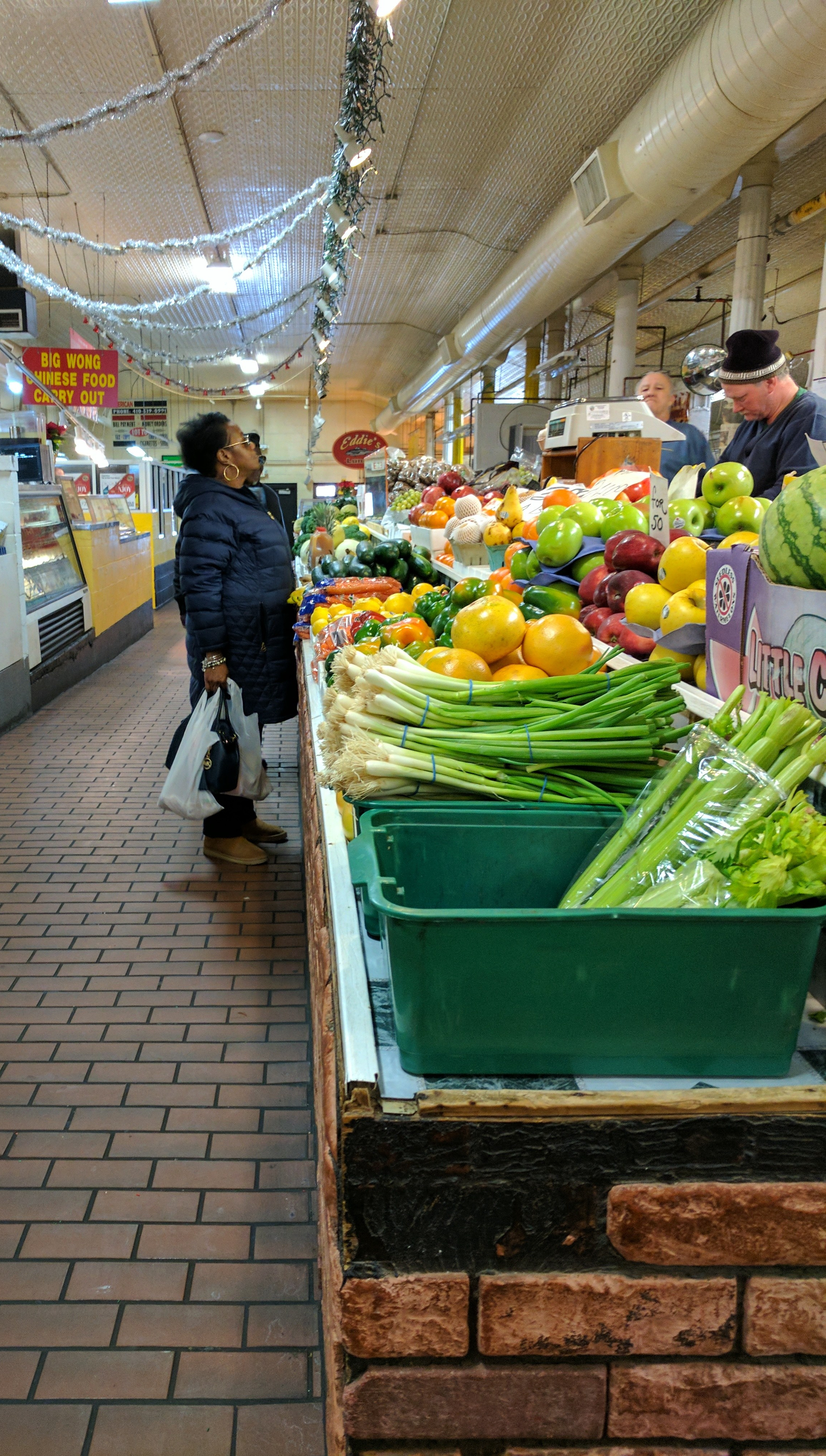
The long history of the market building is immediately evident. Its external walls are adorned with painted ceramic tiles depicting landscapes and portraits of Baltimore luminaries like H.L. Mencken, who lived a few blocks west in Union Square, and Edgar Allen Poe, whose Amity Street house, now a museum, is five blocks northeast of the market. Inside, hand-painted signs–“Bernie’s Deli,” “Lauman’s Quality Meats”–echo a time past, when consumers went to their local butcher or baker to pick up their foodstuffs.
Despite its charm, a walk down the main hall of Hollins Market can leave a visitor dispirited: the lights are dim and there are few tables for customers to eat at. Signs adorn the walls, informing visitors that there is no loitering, and that plain clothes police officers are present “for your protection and security.” The market’s public restrooms are locked—patrons have to ask merchants for keys.
The second floor of the market, once used as a meeting space for local politicians and community groups, is off limits due to asbestos-related health concerns. Within the block-wide building, only 11 vendors remain—long white stalls sit unoccupied alongside similarly empty seating areas.
There is a general sense that Hollins Market hasn’t kept up with the times. “if you look at the pictures when just one person in the family worked, not only would the market be packed, the street would be packed around it,” Browning says. “It’s just a change in the way families work, the way incomes are now. Takes everybody working.”
Part of the responsibility for the market’s anachronisms falls to the Baltimore Public Market Corporation, according to Browning. Some of that comes in maintenance. Sitting in a neighborhood restaurant, Mi Ranchito, Browning points across the street to a vent on the roof of the market, a hole in its worn panels. It’s a minimal issue, he admits, but Browning has little confidence that it will be fixed before it causes water damage. “They’re doing no investment whatsoever back into the market,” he says.
The issues of investment by the corporation, however, extend beyond just maintenance. Even community tasks like decoration feel like pulling teeth to some residents. “What tells you it’s Christmas time at the market,” Lee says. “There’s no bows, there’s no wreaths, there’s nothing to show and tell you ‘hey, come to our market, it’s Christmas.’ Go to cross street, it’s there. Salvation Army, Santa Claus… why are we left behind?”
It is those comparisons that make the relationship between the community and the company running the market more fraught. “The market corporation is solely focused on Lexington Market. Just because that’s the city’s pet project doesn’t mean the others aren’t just as relevant,” Bif says.
Robert Thomas, executive director of the Baltimore Public Markets Corporation, a nonprofit that oversees the city’s market system, in late 2014, agrees. “As it turns out, the lack of investment has been fairly universal. That includes Lexington, it just costs more. It’s a bigger market, it’s in a different location, it gets a diff. kind of clientele, but none of the markets should be neglected,” he says.
He knows, however, that the waning popularity of the market–and its subsequent effects on the local economy–is in some part rooted in the choices by the market corporation. “The disinvestment and the lack of attention has been apparent. How far up that goes I won’t say, but these are city-owned properties,” he says. Previous heads played it safe, he claims, making relying on old models because there was too much risk in adopting modern outreach strategies.
The market has for too long relied on the business models that sustained it at its peak—those
times when throngs would populate the market. “The idea that walk-up traffic is as available now
as it was in the days before supermarkets is an outdated idea,” he says. “To get to the point
where we are serving the customers today in the 21st century we have to figure out what the
customers today want because they have a lot more options.”
That model has served the area’s low-income population well, but also means that there are a lot of missed opportunities to reach out to different consumer groups. “In at least three or four of those communities that are around Hollins Market, those customers have a lot more mobility as well so the market is not their only choice,” he says.
He cites the nearby BioPark on West Baltimore Street as an example. Those businesses, he says, prefer to have phone ordering, delivery, and the ability to use credit cards—none of which seem to have any foothold at the market. Choices like these, however, are not all the responsibility of the corporation. Vendors themselves, he says, can choose to adopt these behaviors if they want to.
Stodginess and stagnation inside the market
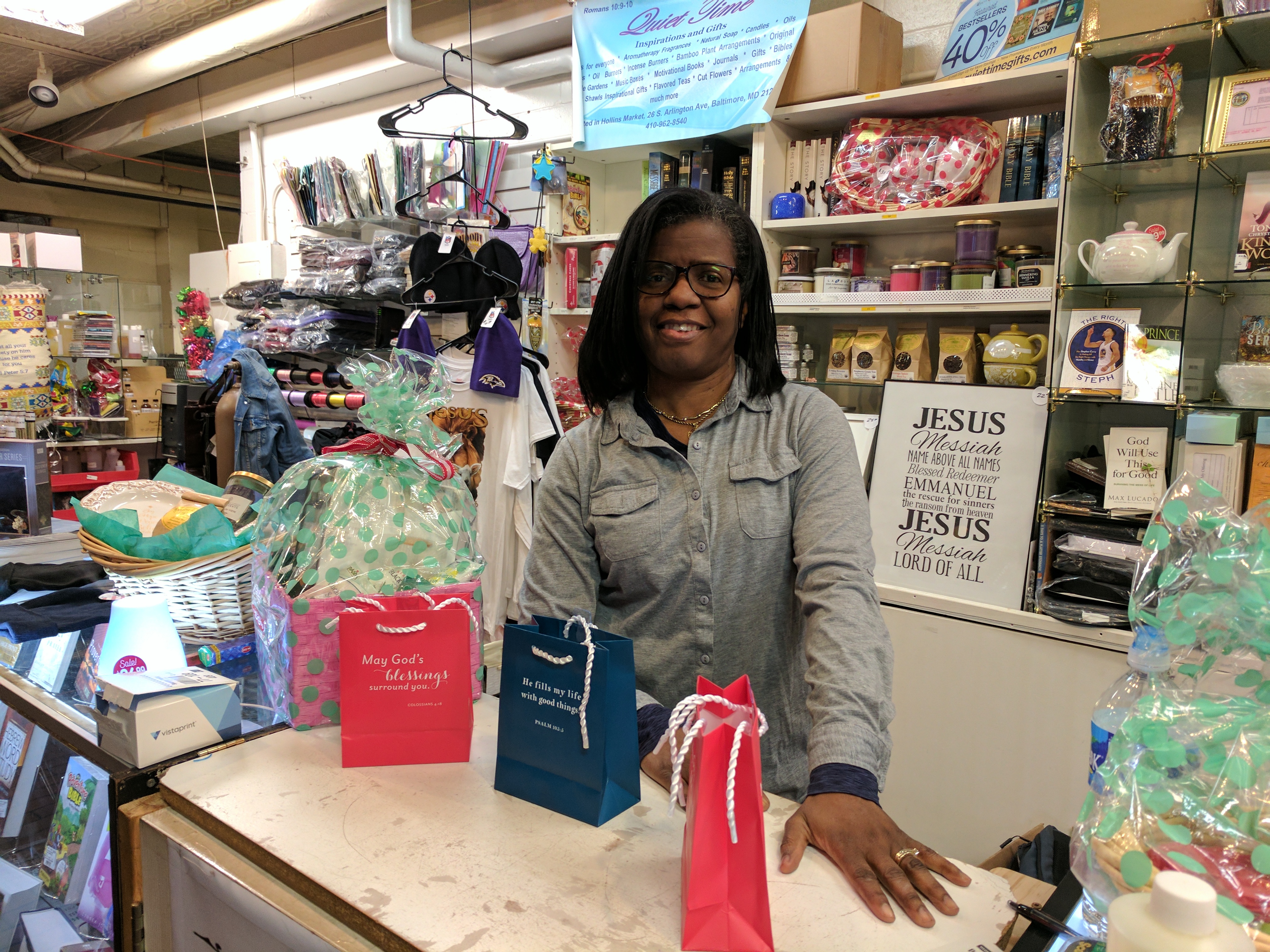
Across the aisle from one of the market’s many sandwich shops is Quiet Time Inspirations, a Christian gift shop run by Kim Hicks, head of the Hollins Market Merchants Association. Hicks, a grandmother with hair just graying at its roots, has a kind, quiet voice and a demeanor to match. She studied ministry, but works sales full time at a corporation in addition to running her shop.
Inspirations has been in operation for about ten years. At the booth, Hicks and her two employees sell Christian novels, crosses, and accoutrements for men of the cloth. Her background comes out in how she interacts with passers- by. Glen, a Vietnam veteran, shouts about a tryst he had in 1956 as he walks by—she casually smiles at him and jokes as she would with any other area resident.
Her counter is coated in displays, pamphlets and knick-knacks. A diffuser, spouting a mist of lavender into their air, sits right at the edge of the counter. Young girls stop and ask about it. One stealthily puts her nose within an inch of it, inhales, and keeps walking while their mother queries about the books behind the counter.
She knows first-hand the struggles of the community she serves. The customers she has are often low-income, or on public assistance. While it’s good that the market serves as a resource for them, it can also be a detriment. People panhandle in the hall, because they know customers will pay with cash.
The market corporation wants to see a more diverse clientele, but as stands, Thomas feels that there’s a general lack of effort on the part of vendors to grow beyond the current customer base. “If we work with a primarily cash and carry group who happen to be in a limited income or lower socioeconomic group but ignore the rest of the other part of the communities around the market, is that reasonable? I would say no,” he says. “It’s not about gentrification, it’s about equity.”
Hicks tends to agree. The market, to both parties, is a community asset—it should serve all types. What she would like to see, she says, is “changing over to the working community, a working class and some upper-class people who would like to come home and say, ‘gosh I don’t feel like cooking let me run in there and get something to eat.’ We miss that because dinner time, we’re closed.”
The hours are too short, Hicks says: “We’re closing when most people are just getting off of work.” Expanding the hours beyond 6 p.m. could help capture working residents after their shifts, and Thomas says they are looking to expand them. But even then, she feels that success would be limited with the market as it is now.
Vendors in the market often sell the same products, right across the aisle from each other. Most of the hand-painted signs above booths mention a deli or a meat of some sort. “Places in here, they don’t have something that would bring the other community-what do you say, two Baltimores?-they don’t have anything to bring them in here,” she says.
“If we’re gonna be open until 8, we need to have something like tacos here, maybe slices of pizza here, maybe something like a chipotle. somebody that does vegan, somebody that does soul food, some Italian,” she says. “I wouldn’t mind hanging out until 8 o’clock because i can come myself, take this home to Nana.”
But when vendors do open stalls, they have difficulty gaining a foothold and doing what they need to do to survive. Her daughter opened a bakery a couple of years ago, and drew in a new group of customers with freshly made confectionaries. “She baked everything but her donuts. Everything was fresh,” she says. When she trialed a lunch menu on a Wednesday–and assortment of paninis, pot pies and other savory foods–she sold out within 20 minutes, and the customers returned the next day, she says.
When her daughter attempted to alter her menu, the market corporation said they would have to raise her rent by around $500. That was too much, according to Hicks—her daughter was already struggling to pay what she needed to rent out the stall. So within a year, her daughter shut down the booth and moved on.
When she first came to the market ten years ago, Hicks saw a broader clientele patronizing more stalls. But as those stalls began to close, she says, “it took away from us those customers that were coming in to get their cake, their pie, their salad. We’ve had other vendors come in and try with new ideas and new things but with it not being a cohesive merchants association to help support one another, it’s hard for someone new to come in and even try to stick it out.”
That merchants association, she says, exists “by name only.” It can be useful, she says, to represent the market on the outside. Because of her status in the building, she has managed to meet with community associations and developers. Aside from that, however, she fails to see much of a purpose in it.
When she was elected president last year, there was excitement that the association would get things done. But when she tried to change the bylaws, she says, other vendors saw it as extra work that they didn’t need to do. When she suggested new ideas–and she was the only one suggesting them–merchants got excited. Then, they got disheartened, “because some of the things they wanted to see happen didn’t happen it’s like ‘oh, it’s too much work,’” she says.
The merchants in the market, in her view, don’t have much interest in catching up to 21st century marketing and sales techniques. “I’ve been in here maybe less time than anyone. People are set in their ways. Outside of this market, life goes on. In order for what’s happening outside to help us be better businesses, we have to do some changing.”
Quiet Time Inspirations has an Instagram account and a Facebook page, but it may be the only one in the market. “If you were to ask any of the merchants today if they were willing to have a website or even a Facebook page, most of them would say no,” she says. “Some of the things that are brought on are because of things people won’t do to change. There is no multiple forms of payment. There is no social media and web presence. Some of the things are brought on because of things that people won’t do to change.”
People on the outside of the market’s walls feel similarly disheartened by the long-time residents. The area has recently been in a flurry of activity, with the release of a sprawling development-focused vision plan by the Southwest Partnership–a “super-neighborhood association”–and subsequent developer interest in both the market and its surroundings.
“They’re missing the big picture because they’re being a little myopic. They’re complaining that business is going down, they’re not making much money, but they’re not realizing that by getting involved with us and trying to restore the neighborhood and trying to recruit companies that will hire [we’ll] have people working here in the daytime,” Browning says.
But those vendors have unique struggles, according to Hicks, that deserve respect. “I ask myself and I pray about it, ‘do I want to continue to do this?” But at the end of the day, I don’t have any spoiled food to throw out. I can come back tomorrow and try it all over again. I still get disheartened, but I don’t have that loss factor—a lot of those food merchants, I know it has to be hard for them,” she says.
“I see so much potential in the market. But it needs a lot of people to work towards making it better.”
The market moves forward
Regarding the development efforts in the area, the market corporation seems to be playing ball. “What happened earlier, what decisions, what budgetary constraints were in place before to discourage investment: it’s before. So that’s what I’m trying to overcome,” Thomas says. “We have to shift the mindset to the point where all the markets are valuable, all the communities are valuable. All of them need to be served in a 21st century, first-class way.”
Thomas was only appointed to his position in 2014, and merchants like Hicks have noticed. “Earlier this year, they had a meeting with individuals from each market. They did make an effort to try to get a feel for what’s going on,” she says. “There was a changing of the guard, so to say. If you look at the history of the market, the leadership of it prior, it’s just always been… it’s antiquated, just like the markets are.”
In the past year, Scott Plank, brother of the Under Armour CEO Kevin Plank, purchased 50 properties surrounding the market, largely from one owner. In September, WarHorse CDC–the nonprofit arm of Plank’s real estate operation–met with members of the Hollins Roundhouse Neighborhood Association to discuss the terms of their acquisitions, and their pursuit of a management contract with the market corporation.
The company declared its intent to work with existing redevelopment efforts, but also its desire to invest $5 million in the market to redevelop it. WarHorse also acknowledged that rents would probably rise after 5 years, leading some residents to worry about displacement of residents.
While WarHorse owns much of the surrounding property, they cannot entire an agreement with the market corporation until offers are opened up to the public. “What’s happened here is we’ve simply had private interest, express interest in the market,” Thomas says. “Rather than rejecting that out of hand, the process has to be that we invite any other private interest to do that. Let’s see what the private interests have to offer.”
The offer comes with terms, according to Thomas: “The mandate for Hollins Market is that it must remain a market. It’s still gotta be a market that serves communities and citizens around it.”
But even then, there are worries about that development’s impact on the inside of the market. “It’s gonna be a regentrification of the public market,” Hicks says.
“You have people who have already sold their homes to WarHorse. A lot of people who live in the community will be bought out, or pushed out,” she says. Worries about development’s impact inside the market exist, too.
With growth targeting a wider demographic, there is a risk that lower-income residents won’t be able to shop at the market anymore. That one-dollar donut becomes a $1.95 donut,” Hicks says. “It will price some people out, but if you have redevelopment, I don’t see how you can avoid that.”
For the vendors, there’s danger in losing their core customer base if they aren’t flexible enough to adjust to their new audience. According to both Hicks and Thomas, it’s likely that rent is going to go up, and that might mean some vendors who have been there for upwards of forty years simply leave.
Hicks knows these vendors. “For many of them it’s a dollars-and-cents thing. As long as they see it adding up to a win-win, they’ll stay. If my rent goes up and you can promise me more foot traffic, I’m all for it,” she says.
But some of them, she says, won’t be willing to stick through it. They’re tired, and many of them don’t have children to take their businesses over for them. “They don’t have a generation that’s willing to come in and cut meat and fry eggs,” she says. “Their next best thing is to say ‘ok, I’m gonna hang it up.’”
In the neighborhoods, however, it can be hard to hear anything but positivity. The plans that Bif has heard have him excited: walkways built through the building for visibility, safety and access to surrounding businesses, merchants being able to sell both inside and outside of the walls, a renovated second floor providing community space. He’s all in, both on developments by WarHorse in the buildings surrounding the market, and any potential development in the market building.
“We’ve tried 30 years of disinvestment in our commercial infrastructure,” he says. “I have to get in my car to get a few nails, to get my dry cleaning, to get my groceries, if I want to go see a movie, anything. if they do what they’re saying, even if you have to spend a little money. that allows our neighborhoods to get to the next plateau.”
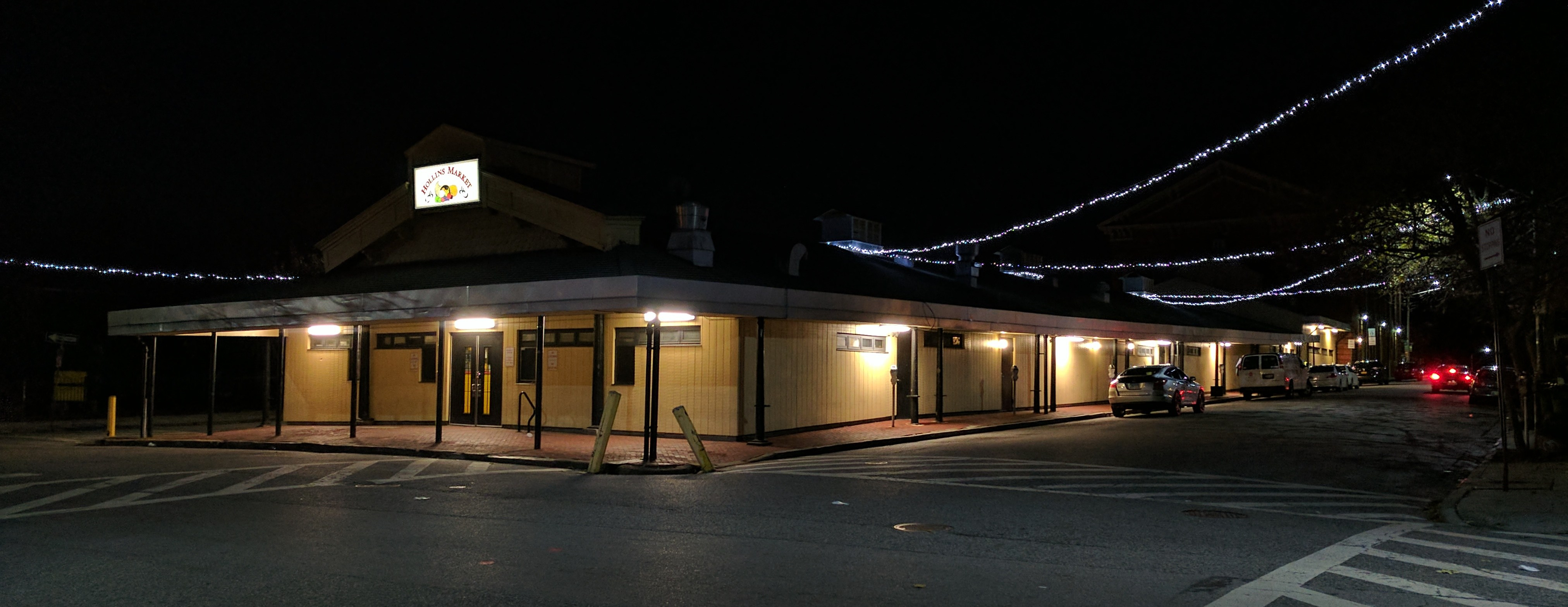
It’s a week and a half after Bif spoke with the construction workers next to Mi Ranchito. The building now sports a notice of foreclosure. Above the street, a strand of Christmas lights bounces from the market building’s edge to the surrounding buildings, zig-zagging its way around the block. Wreaths dangle from hooks above the market’s main entranceway—just inside, a Christmas tree is ringed with gifts. Poinsettias, gifts from the market corporation, sit atop most of the counters in the building.
The market’s problems are not gone—the decorations are almost entirely the work of Hicks and the Southwest Partnership. Still, it is hard to resist cracking a smile at the festive spirit of the patrons inside. Today, there are a lot more than usual.
The market’s halls are busy, a rare feat nowadays. Hicks chalks it up to the decorations and the quartet she’s brought in for the day. Three mics and three matching stools sit alone on the stage.

Visitors, young and old accumulate around them. A man jokes with Hicks about karaoke, and just then, four men in glistening red jackets and slacks stream out of the public bathroom–key in hand–and walk in a row to the stage.
They do their job well: they belt out lyrics to popular gospel music, and the crowd sways and snaps photos on their smartphones. An older woman, in a blue plaid jacket and jeans that sag to the floor, dances hard enough that her flip phone falls to the floor—she stares at it, and laughs. A pedestrian nearby picks it up, and the woman goes back to dancing.
Normally, the market couldn’t afford such an event. Hicks pays out of pocket for any events in the building, ranging from selfies with Santa and the Easter Bunny to chess tournaments. But that’s the best part: these guys did it for free. All the way down the hall, their notes reverberate: “Teach us to love one another / Jesus, we won’t let you down.”
 Sam A. Manas